


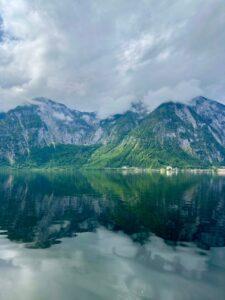
Quick context, because Hallstatt is older and stranger than the Instagram version lets on. It sits in the Salzkammergut, Austria’s lake district, and the whole region is on the UNESCO World Heritage list. The name is a giveaway: Hall comes from an old word for salt, and people have been pulling salt out of the mountain above the town for something like 7,000 years — it’s often called the oldest salt mine in the world. There’s an entire Iron Age culture named after this one village. Hallstatt culture. That’s how big a deal the stuff buried in this hillside was.
I find that genuinely moving, actually. You’re not the first person to be up here cold and out of breath. People have been climbing this exact rock for their livelihood since long before the word “Austria” existed.
Our peak for the day was the Plassen — the mountain that rises straight up behind the town, the same one the salt mine has been carved into for millennia. We set off at first light, past the salt-mine funicular and onto the trail proper. The first stretch is generous — switchbacks through forest, the town shrinking below you bit by bit, the lake turning to a sheet of pewter through the trees. Easy. Almost smug. That didn’t last.
Where it stopped being a walk
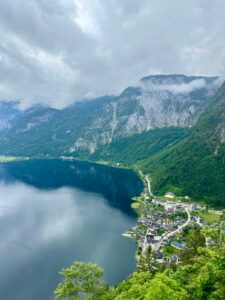
Past the easy part, the trail changed its mind about being a trail. It turned into scrambling — the kind where you stop walking and start using your hands, where you’re hunting for the next foothold and very deliberately not looking down at the drop on your right.
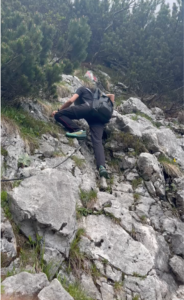
For people who are fine with heights, I’m told this is the fun bit. For me it was a full-body negotiation. One hold. Test it. Trust it. Move. Repeat. Don’t think about the exposure. Don’t think about the noodle-legs. Just the next hold, and the one after that.
And then the weather, which had been threatening all morning, delivered. First rain — slick rock, every surface you’re gripping suddenly wet, your shoes deciding they’d quite like to slide. Then, higher up, snow. In June. This isn’t as mad as it sounds: the Dachstein massif next door keeps glaciers year-round, and at altitude the cold just doesn’t get the memo about summer. But knowing why there’s snow doesn’t help when it’s sitting in patches exactly where you need to put your feet, in exactly the spots where you have the least room to negotiate. A move you’d shrug off on dry rock becomes a completely different question with snow on the ledge and rain in your eyes.
So close. And then we turned around
We were near the top of the Plassen. Close enough that every cell in me wanted to just push — gut it out, tag the summit, get the photo, win the day.
And then we reached a section where snow had settled into one of those awkward spots — narrow, exposed, no clean line through — and we stopped. We looked at it. We looked at each other. And we made the call to turn back.
I’d love to tell you I was wise and serene about it. I was not. Turning around that close to the top feels genuinely awful, like closing a book one chapter from the end. But the mountain doesn’t care how close you are, and snow on an exposed scramble with bad footing is not a thing you negotiate with. The summit is optional. Getting down is not.
So we went down.
Soaked, and then a platform over the void
By now the rain had properly settled in, and we descended through it — soaked to the skin, careful with every wet rock, the adrenaline doing all the work my legs no longer volunteered for.
Off the worst of it and thoroughly drenched — you can tell exactly what kind of day it had been. Photo by the author.
And then Hallstatt played its little joke. The way down delivers you, of all places, onto the Skywalk — the “World Heritage View,” a metal platform bolted straight out over roughly 360 metres of nothing. So after everything, there I was: drenched, wrung out, edging onto what is essentially a diving board suspended over the entire town.
Here’s what I keep relearning about being scared of heights: the fear doesn’t leave. You just get better at standing in it — even soaked, even spent, even when the day has already taken more than you had.
The cry I didn’t see coming
Here’s the part I wasn’t ready for.
The rest of the descent, I was fine. Locked in. Holds, footing, breathe out, move. It was only when we finally stepped onto safe, flat ground — when my brain at last let go of the rope it had been white-knuckling for hours — that the whole thing arrived at once.
I started crying. Not sad-crying, exactly. More that every drop of adrenaline I’d been sitting on for the whole way down had nowhere left to go, so it just… came out. Relief and fear and disappointment and I-actually-did-that, all in one go, with no neat label on any of it.
And then I looked up.
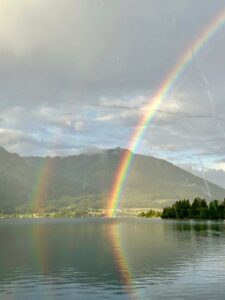
A rainbow. Landing right on the water, like someone had aimed it. And then — because the day clearly wasn’t finished with me — a second one beside it, the whole thing doubling over the lake and reflecting back up off the surface.
I’m not going to pretend it was a cosmic message. It’s light and water and the right angle, nothing more. But standing there — snot and tears, legs finally my own again, looking at this absurdly beautiful thing the sky had decided to do — I felt hopeful. Not because we’d reached the top. We hadn’t. But because I’d carried the fear the whole way up and the whole way down, and I was still standing, and the world had handed me a double rainbow anyway.
You don’t always get the summit. Sometimes you get the rainbow instead.
The next day: an easier kind of beautiful
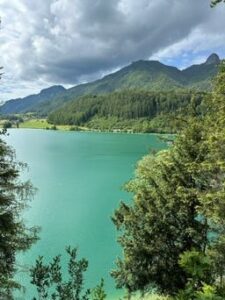
The next morning, my legs filed a formal complaint, and we half-listened. We still did a long walk — but a gentle one, along the water this time. Sunshine, finally. A lake so clear and green it looked photo-shopped. Sailboats. Limestone cliffs dropping clean into the water without a single scramble move required of me.
After the day before, this felt like a reward I hadn’t quite earned but was absolutely going to accept. No noodle-legs. No snow in the wrong places. Just kilometre after kilometre of easy, ridiculous beauty and the quiet smugness of having survived the hard one.
And at the end of it, the only summit I’ll happily claim: two Aperol spritzes, a wooden jetty, and a lake the colour of sea glass. Worth every shaking step of the day before.
What I carried home
I didn’t reach the summit. I cried in front of a lake. I’m still scared of heights — that didn’t magically resolve itself on the way down.
But I went up a mountain that genuinely frightened me, in rain and snow, over the kind of ground that makes my legs forget their one job, and I made a hard, unglamorous call near the top because getting down mattered more than the photo. And then the sky handed me a double rainbow for my trouble.
And the contradiction I opened with? Still unresolved. I’m scared of heights and I’m already thinking about the next mountain — the two feelings as loud as ever, still refusing to cancel each other out. I’ve stopped expecting the fear to leave. I think the pull and the fear might actually be the same muscle: the part of me that wants to be somewhere a little bigger than I can comfortably handle.
If you’re someone who’s scared of the very thing you keep chasing — heights, edges, whatever your version is — I won’t tell you the fear disappears. It doesn’t. You just find out you can carry it a lot further than you thought.
Turn around when you have to. Cry if you need to.
And keep an eye on the sky on the way down.
.gif)


0 Comments